Sam’s Top 100: 70-61

By Sam Federman
70. Memphis Tigers (American)
It’s September and Penny Hardaway is still scrambling to add pieces to his frontcourt. That should tell you a lot about Memphis for this upcoming season. This Tiger team is as thin as last year’s group, but lacks the superstardom of PJ Haggerty and Dain Dainja’s interior presence.
The frontcourt currently features Aaron Bradshaw, William Whorton, Hasan Abdul-Hakim, Ashton Hardaway, Simon Majok, and Arop Arop. Of those guys, there is not much proven production. Abdul-Hakim has a fun skillset and some versatility, while Bradshaw has size and athleticism, but there is still work to be done.
The backcourt is a little more proven, with Dug McDaniel coming in from Kansas State, Zachary Davis and Quante Berry coming in on the wings, and Julius Thedford moving over from Western Kentucky. Sincere Parker is also in the mix, but is in the middle of a legal situation at the moment.
69. Syracuse Orange (ACC)
In Red Autry’s two years at Syracuse, the Orange have finished with their second and third worst rankings of the KenPom era (the worst? Jim Boeheim’s final year). It’s probably for the better that the Orange have a nearly completely retooled roster after last season, but it’s important that Syracuse returns its two top players.
JJ Starling led the team in scoring last year, and likely will again as a scoring combo guard, but he’ll work next to Georgia Tech transfer Nait George this time. George gives the Orange a proven high-major point guard who can move the ball around and also score for himself.
The other returnee is Donnie Freeman, who missed the final 19 games of the season with injury, but flashed high-end offensive skill at 6 foot 10 when he did play. He’s more of a four than a five, but Syracuse may ask him to play the five, as athletic UCLA transfer William Kyle is the only true five expected to be in the rotation. Kyle will improve Syracuse’s ball screen defense, a major weakness with Eddie Lampkin last year. Ibrahim Souare isn’t a true five, but may also play some minutes at the center spot.
Nate Kingz and Tyler Betsey come in to add shooting on the wing, with Kingz expected to play an important role in the backcourt. Freshman Sadiq White will find his way on the floor plenty thanks to his defense, but how much time and where he will play are still uncertainties.
68. Georgia Bulldogs (SEC)
Georgia is coming off of its best basketball season in years, making the NCAA Tournament for the first time since 2015, and as a single-digit seed for the first time since 2002. So what does Mike White have for an encore? A significantly worse roster that likely sees the Bulldogs returning to the bottom tier of the SEC.
In order for Georgia to replicate its strength on the interior from last season, Somto Cyril will need to have a breakout season. He’ll be one of the better rim protectors in the SEC, but will he be able to impose himself on the offensive side of the ball? Justin Abson and Dylan James are back as well, but the frontcourt isn’t quite as deep as it was last season with Newell in the mix.
Kanon Catchings has some enticing skills, but needs to be more consistent. Smurf Millender and Jeremiah Wilkinson make up a much smaller backcourt than the lineups that Georgia threw out last year. Blue Cain returns, and has a chance to be this team’s top scorer with more opportunity vacated. Saint Mary’s transfer Jordan Ross could be a solid two-way guard.
67. Oklahoma State Cowboys (Big 12)
Oklahoma State has a lot of players who had the ball in their hands a lot at their last stop. That starts with Green Bay transfer Anthony Roy, who led college basketball in scoring before being controversially held out of games by head coach Doug Gottlieb for violating team rules, and then an injury that claimed the rest of his season. Who knows if he’s going to last the whole season and do so while playing at a high level for the Cowboys, but the ceiling is there.
Kanye Clary is a ball-dominant guard who missed most of last season at Mississippi State after transferring from Penn State. How will the dynamic between Roy, Clary, and Seton Hall transfer Isaiah Coleman materialize? And how do UMass transfer Jaylen Curry and LSU transfer Vyctorius Miller fit in the backcourt?
In the frontcourt, Oregon State transfer Parsa Fallah is a great back-to-basket threat, but how much will any post player get to touch the ball with a backcourt full of scorers? UAB transfer Christian Coleman and returning forward Robert Jennings will likely be the lower usage, hustle players in the lineup.
This is one of the teams I’m most fascinated to watch on night one of the season, but I’m pretty sure it will end without an NCAA Tournament berth.
66. TCU Horned Frogs (Big 12)
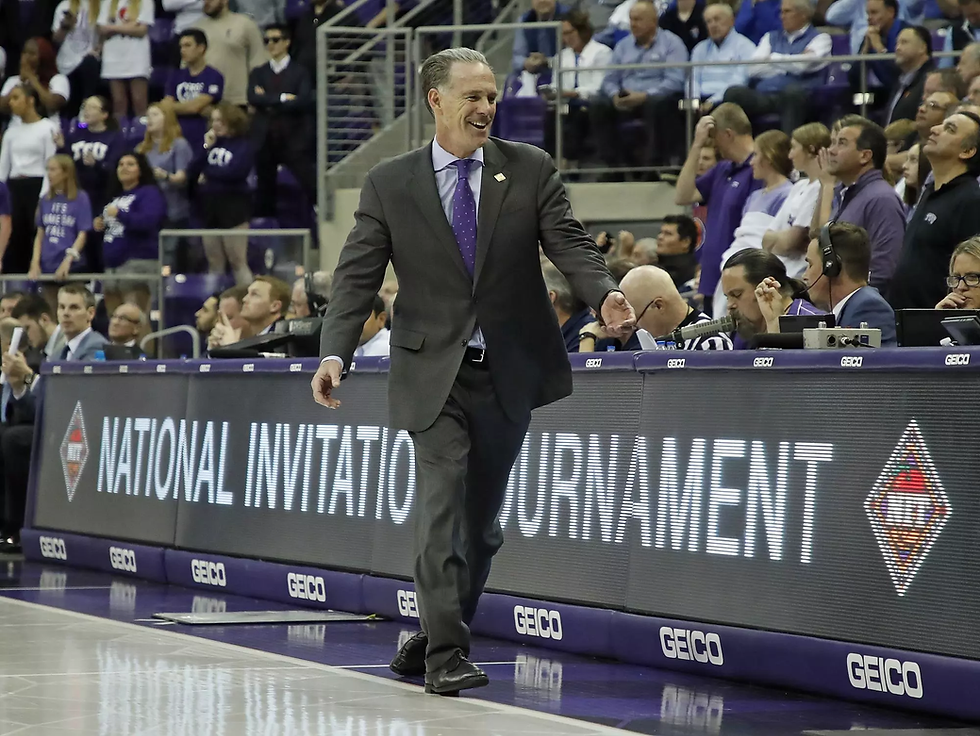
The lack of any sort of cohesion offensively last season torpedoed the Horned Frogs’ campaign, so this year, Jamie Dixon made a clear effort to get proven playmakers and play finishers on the roster.
Iowa transfer Brock Harding was third in the Big Ten in assist rate last year, and will direct traffic for TCU. Jayden Pierre isn’t quite as decorated of a playmaker, but he has three years of experience as a true point guard in a high-major league. The main shooters will be Utah Valley transfer Tanner Toolson (35% on 5.6 attempts per game last year) and Oregon State transfer Liu Lelevicius (38% on 2.9 attempts per game). If the Frogs can get a breakout from sophomore Micah Robinson, he’d be another potential outside shooter.
FIU transfer Vianney Salatchoum brings an interior presence, while David Punch has a chance to make a sophomore breakout with his physicality and versatility on the defensive end. Punch and Jace Posey bring the typical TCU intensity that you’ve become familiar with under Dixon.
65. Minnesota Golden Gophers (Big 10)
Niko Medved is back home in Minneapolis as the head coach of the Gophers, and has a chance to bring them out of the Big Ten basement.
Defensive ace forward Jaylen Crocker-Johnson followed Medved from Colorado State. He’s the ultimate piece to start your roster with since he’s such a versatile defender that you can mold many different lineups around him. Medved bought low on Cade Tyson, looking to unlock the version of the player that was so highly coveted in the previous portal cycle. He also added Davidson transfer Bobby Durkin to form a duo of 6 foot 7 shooting wings.
High-scoring mid-major transfers Langston Reynolds (Northern Colorado) and Chansey Willis Jr. (Western Michigan) join sophomore Isaac Asuma in a backcourt with potential to score from different spots and run Medved’s system.
BJ Omot only played four games for Cal last season, but was a star at North Dakota the two years prior, and has a chance to impact on both ends for the Gophers.
Minnesota’s center spot will be split between San Jose State transfer Robert Vaihola and Central Arkansas transfer Nehemiah Turner.
64. Dayton Flyers (A10)
Dayton’s transfer portal haul features a few exciting buy-low candidates to join returning bookends Javon Bennett and Amael L’Etang.
L’Etang is set to have a breakout sophomore season as a well-rounded 7 footer. He’s mobile with good touch and understands how to use his size. He could be one of the best bigs in the A-10 this year. Meanwhile, Bennett is in his third year at Dayton, and he took a leap last season to become a knockdown shooter in addition to handling the ball and pressuring the ball on defense.
Georgia transfer De’Shayne Montgomery is an athletic combo guard with serious length to impact the game defensively and a solid offensive game as well. He was MAAC Rookie of the Year two seasons ago at Mount St. Mary’s, but didn’t find a rhythm at Georgia. Jordan Derkack was the NEC Player of the Year at Merrimack two years ago, but didn’t translate well to the Big Ten. His drop to the A-10 will help accentuate the strengths in his feel that didn’t shine through last season. Bryce Heard and Malcolm Thomas are two other buy-low additions that could help out.
Iona transfer Adam Njie adds some wiggle and scoring off the bounce to the backcourt, while CSUN transfer Keonte Jones gives playmaking and versatility in the frontcourt.
63. South Florida Bulls (American)
I’m all in on Bryan Hodgson as one of the best young coaches in college basketball. I’m setting some seriously high expectations on his first season at South Florida – a program that has only finished in the top 70 twice in the KenPom era.
Hodgson brought Izaiyah Nelson and Joseph Pinion with him from Arkansas State. Nelson will combine with LSU transfer Daimion Collins to form a frontcourt that should dominate the glass and the baseline in the American.
Pinion is an excellent shooter that has a super green light in Hodgson’s system. He’ll be fed the ball by James Madison transfer Xavier Brown and Lincoln Memorial transfer Wes Enis – who was one of the best players in Division II last year. Enis averaged 20.1 points and 3.1 assists per game last year and shot 41% from three himself. He’ll be one of the best players in the conference on day one.
USF is also a deeper team, as Josh Omojafo was a key piece for a great Robert Morris team last season and Devin Haid was a key piece for a great Central Connecticut team. Oakland transfer Isaiah Jones adds even more physicality to the frontcourt, and Onyx Nnani is an underrated freshman with impressive skills at 6 foot 9.
62. Utah State Aggies (Mountain West)
Utah State made its third consecutive NCAA Tournament with a third different coach last season, but how can Jerrod Calhoun build off of year one?
It starts with the return of superstar guard Mason Falslev. He stands just 6 foot 3, but plays above his size as an elite rim finisher, but stepped up his outside shot to 39% last season. He’s one of the early favorites for Mountain West Player of the Year as a junior.
Three other pieces from last year’s roster return, in guard Drake Allen, big man Karson Templin, and wing Tucker Anderson, who is looking for a bounce back season. That group is joined by a few exciting transfers in the backcourt. Kolby King didn’t work out at Butler, but is a talented enough scorer to be a big time addition in the Mountain West. Vanderbilt transfer MJ Collins joins him in the backcourt with three years of being a contributor at high-major programs.
Texas A&M Corpus Christi transfer Garry Clark adds size and rebounding to bolster the wing and frontcourt group. He averaged 14.9 points and 7.7 rebounds last season for the Islanders. Luke Kearney has some experience in the Mountain West with Air Force, and Zach Keller becomes the latest transfer between Utah and Utah State.
61. Notre Dame Fighting Irish (ACC)
Micah Shrewsberry had a few major recruiting wins for the Class of 2025, but now is the time to take those wins to the court following two losing seasons in his first two years at Notre Dame.
Markus Burton and Braeden Shrewsberry each returning for year three is a victory in itself. The two make up one of the more dynamic backcourts in the ACC, but weren’t as consistent as they hoped for last year. Maybe a third year in the system is what those two need to blossom into an NCAA Tournament starting backcourt. Burton is one of the top scorers in the conference, while Shrewsberry is a high-volume sniper from beyond the arc.
Freshman Jalen Haralson was the biggest of ND’s recruiting wins. He’s a five-star recruit from the state of Indiana that the Irish beat out the Hoosiers to get. He needs to contribute at a high level on day one. Sir Mohammed has the chance for a breakout sophomore season as well.
Northern Arizona transfer Carson Towt and Kebba Njie form a solid big man duo, while underclassmen Cole Certa, Garrett Sundra, and Ryder Frost will play a role in Notre Dame’s wing and forward rotation as well.